
For heavy industry, hiring a specialized Manufacturing UX/UI Designer is now the defining factor in securing marketplace survival over raw engineering precision alone. In 2026, the global supply chain operates at breakneck speed, heavily augmented by conversational search algorithms and automated pre-vetting models. If your industrial machinery specifications, payload capacities, and regulatory certifications are locked inside unstructured code or hidden behind “clean” aesthetic whitespace, your facility is practically invisible to corporate buyers.
This comprehensive guide exposes how traditional, minimalist agency layouts create catastrophic information friction for engineers. We will explore the psychological differences between retail consumers and B2B procurement officers, the hidden financial costs of “Digital Rust,” and why pivoting to high-density data architecture is the only proven method to capture high-ticket contracts in the modern manufacturing era.
The $4.2 Million Cost of Precision Redefined
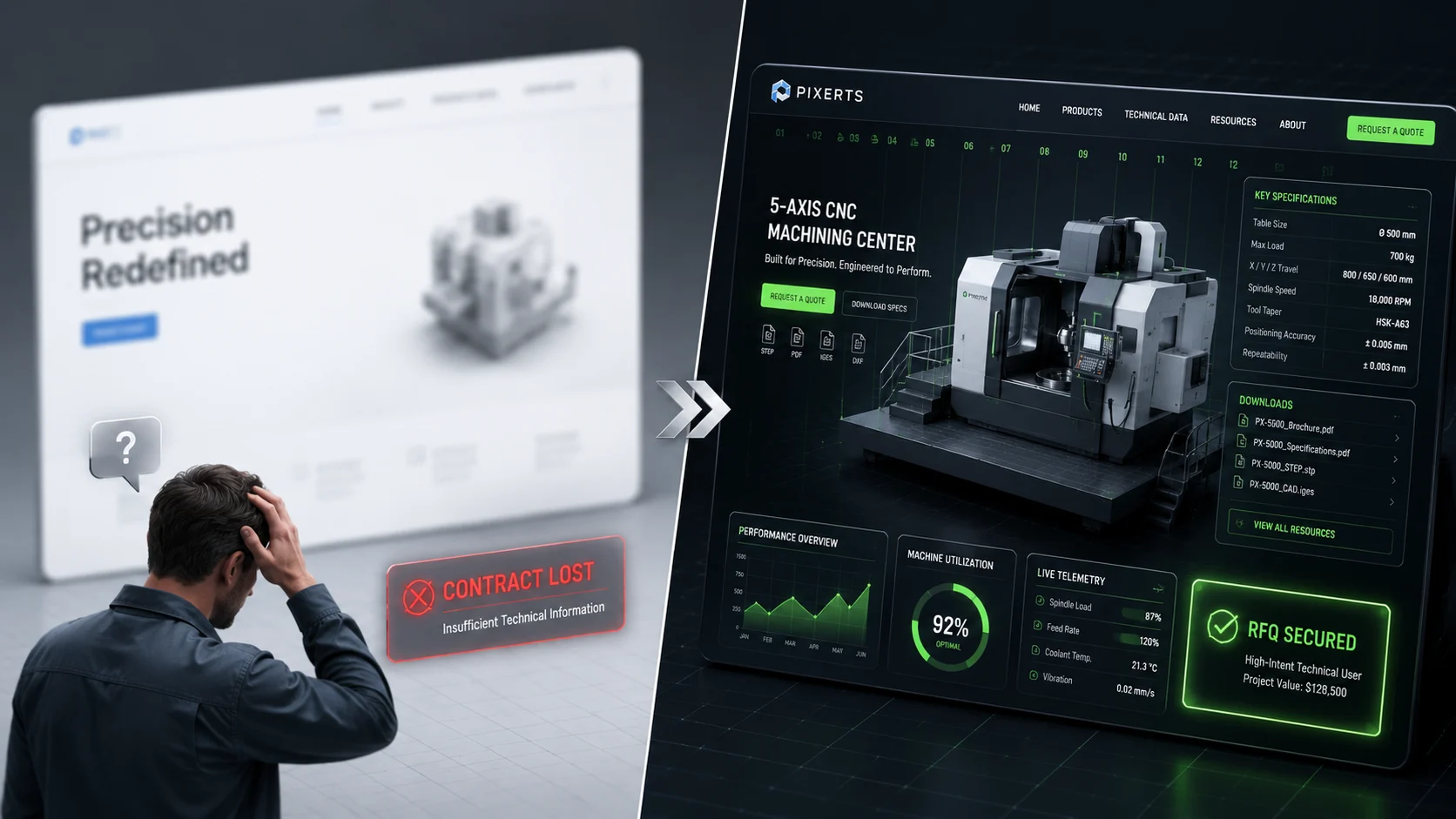
To understand the sheer scale of this problem, we must step inside the workflow of a modern enterprise buyer. Consider David, the Lead Procurement Engineer for an international aerospace Original Equipment Manufacturer (OEM). On a Thursday morning, David is tasked with finding a regional contract manufacturer capable of integrating highly automated, 5-axis continuous milling machines into a new localized supply chain. The project requires strict AS9100D compliance and the ability to machine Inconel 718 with sub-micron tolerances.
David has a massive CAD assembly open on his primary monitor. On his secondary monitor, he opens the website of a well-funded, highly capable CNC machining facility recommended by his supply chain director.
When the site loads, David is greeted by a massive, edge-to-edge cinematic video of a robotic arm spraying coolant in slow motion. Over the video, three words slowly fade in: “Precision. Innovation. Redefined.” There is no persistent navigation bar—just a hidden “hamburger” menu in the top right corner. The screen is a vast expanse of elegant, empty white space.
David needs to know three very specific things immediately:
- Do their trunnion tables possess a minimum 500kg payload capacity?
- Do they explicitly list exotic alloy proficiencies?
- Is their facility actively AS9100D certified?
He scrolls down. He finds a beautifully written paragraph about the company’s “passion for tomorrow’s excellence” and a quote from the CEO about “building the future.” Frustrated, he clicks the hidden hamburger menu, navigates to “Solutions,” and finds a page with three large, abstract SVG icons. The actual machine capability list—the only data David actually cares about—is nowhere on the page. Eventually, he realizes it is buried inside a downloadable PDF catalog named Company_Overview_Final_V3.pdf that takes fifteen seconds to render on his browser.
David closes the tab in under eight seconds. He moves to the next supplier on his vetted list.
That facility just lost a $4.2 million OEM procurement contract. They did not lose it because their machinery was inferior. They did not lose it because their pricing was too high. They lost it because they treated a high-stakes industrial machinery portal like a luxury sneaker brand. By prioritizing emotional aesthetics over raw engineering telemetry, they engineered their own failure.
The Consumer Retail Illusion in B2B Markets
For the past decade, generalist creative web design agencies have pushed a massive, viral trend across the internet: minimalist consumer layouts. They train corporate brands to slash text blocks, expand whitespace, use abstract emotional imagery, and focus entirely on “lifestyle” positioning.
While that philosophy works flawlessly for direct-to-consumer goods—where the goal is to trigger a fast, emotional impulse purchase—it is a structural disaster for the industrial machinery sector.
When a mechanical engineer, plant manager, or chief technology officer visits an Industrial Website Designer, they are not making a casual impulse purchase based on a feeling. They are performing a calculated, high-pressure, highly scrutinized technical audit. Their job is to mitigate risk. They are looking for undeniable, mathematical validation.
Minimalist design choices that hide critical information confuse human engineers. Engineers are trained to read complex blueprints, detailed schematics, and dense datasheets. When you hand them a website that looks like a modern art gallery, you are speaking the wrong language. You are forcing them to hunt for the data they need, which instantly degrades their trust in your technical sophistication. If your digital presence is disorganized and vague, the subconscious assumption is that your factory floor is equally disorganized and vague.
The Core Enemy: Information Friction
In the B2B industrial machinery sector, your greatest enemy is not a competitor across the ocean offering cheaper labor; your greatest enemy is Information Friction.
Information friction occurs anytime a user must exert unnecessary cognitive or physical effort to extract a specific data point from your interface. In the digital ecosystem, friction is cumulative. Every extra click required to find an axis travel limit, every vague headline they must decipher to understand your core competency, and every flat PDF they are forced to download builds friction.
When friction exceeds an engineer’s patience threshold, they abandon the site. Generalist web designers create friction on purpose to make a page look visually “cleaner.” An elite B2B UX Designer does the exact opposite: we eliminate friction by surfacing dense, highly organized data immediately.
The Three Pillars of Digital Rust
Information friction is usually caused by “Digital Rust”—archaic web practices that degrade the user experience. The three most common forms of Digital Rust on manufacturing websites include:
- The PDF Data Graveyard: For thirty years, manufacturers have exported their parts catalogs and machine specs as massive PDF files. While this is fine for printing physical brochures, it is a nightmare for web UX. Mobile users cannot easily read them, they cannot be filtered or sorted, and search engines struggle to index the data accurately.
- The Hamburger Menu on Desktop: Hiding your core capabilities (CNC Machining, Injection Molding, Custom Automation) behind a single click-to-open icon on a desktop monitor forces the user to guess what you do. Persistent, highly visible mega-menus are mandatory for industrial sites.
- The “Email Chain of Death”: Placing a generic “Contact Us” box that asks only for a Name, Email, and Message. Engineers cannot accurately describe complex geometric dimensioning and tolerancing (GD&T) in a blank box. This causes them to abandon the form, or forces your sales team into a week-long email chain just to get the required CAD files.
How Manufacturing UX/UI Designer Apply HMI Principles
To survive in modern industrial markets, your website layout should not be inspired by consumer magazines. It should be inspired by the control panels bolted to your factory floor.
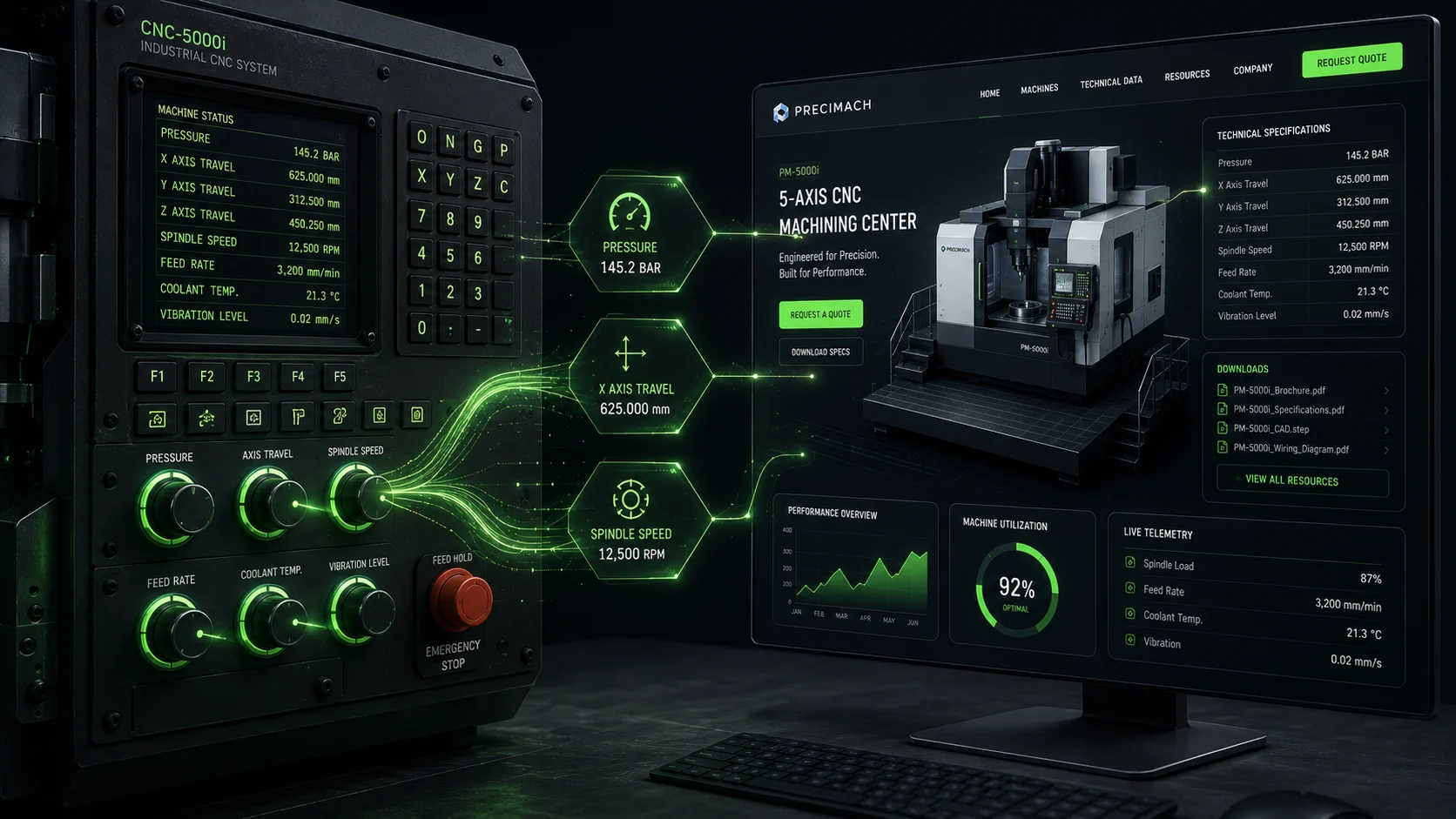
In industrial engineering, HMI principles (Human-Machine Interface) dictate how human operators interact with complex, dangerous hardware. Look at the control screen of a Fanuc or Siemens CNC machine. A good HMI dashboard does not hide critical spindle speeds, coolant pressures, or emergency stops behind a minimalist drop-down menu to “save visual space.” It displays all vital telemetry upfront, using high-contrast grids, logical visual hierarchy, and immediate color-coded alerts.
Your website must adopt this exact HMI discipline. By replacing empty whitespace with structured HTML data tables, and vague marketing copy with explicit engineering parameters, you align your digital presence with the expectations of a highly analytical engineering mindset.
The Universal, Platform-Agnostic Blueprint
Achieving this level of precision requires a complete separation of visual strategy from backend code. We engineer layouts universally inside Figma, mapping out strict 12-column grid disciplines before a single line of code is written.
This platform-agnostic approach ensures that the fundamental architecture of your data remains pure. We build an overarching design system—a library of UI components—that dictates exactly how a machine spec table, an ISO certification badge, or an RFQ form should look and behave.
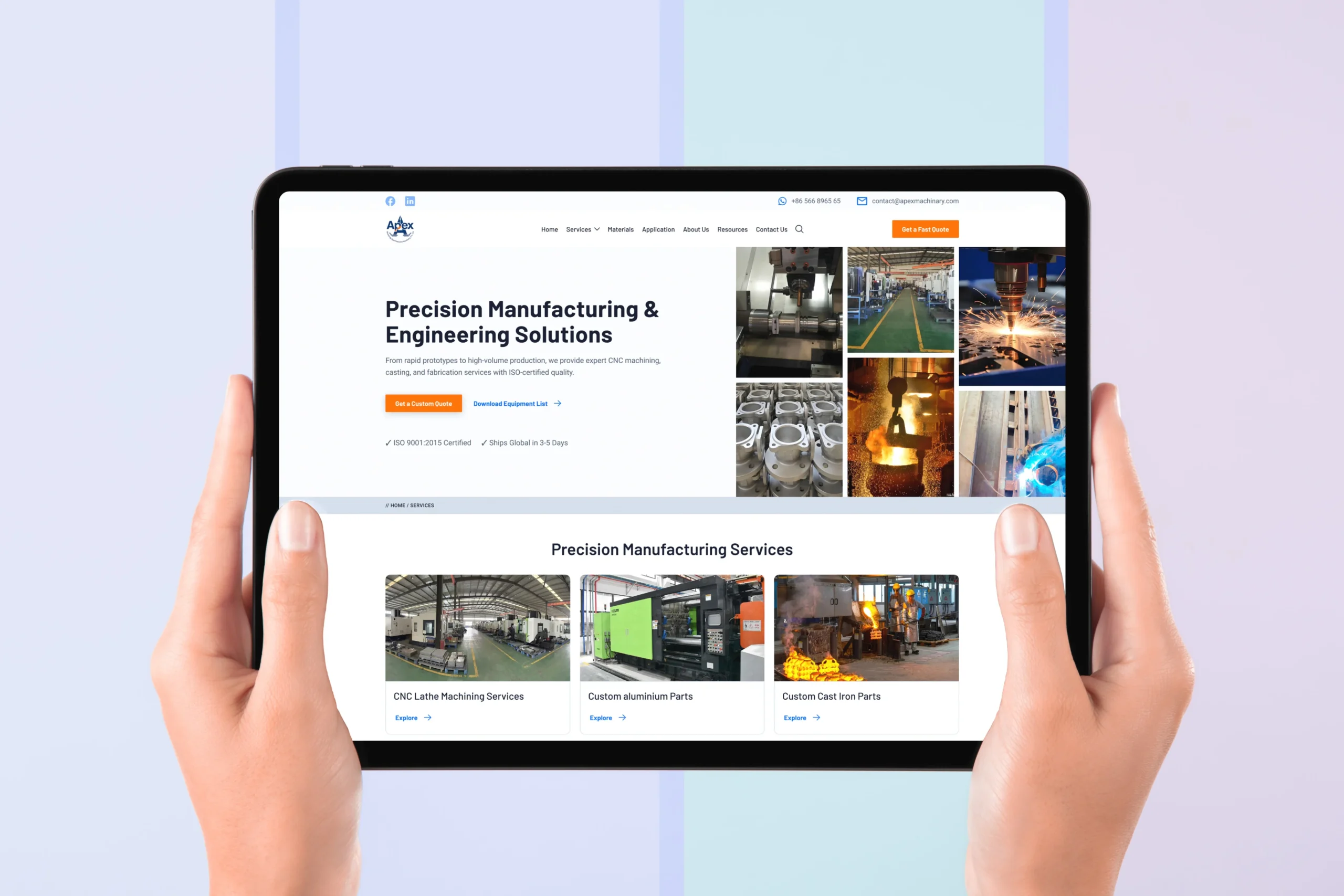
When it comes time for development, my co-founder at Pixerts, S.M Sadman Rafid, and our development team translate these blueprints into reality. While we heavily utilize agile environments like WordPress and Elementor Pro for rapid, light-weight scaling, the core code structure is designed universally. We are never boxed into a single tool’s limitations. If a specific industrial search filter requires custom Javascript or native PHP to execute flawlessly across a catalog of 10,000 SKUs, it is built to exact specifications. This guarantees that your site remains blindingly fast, passes all Core Web Vitals checks, and is permanently scalable.
The AI Procurement Reality: Algorithms Cannot Read Whitespace
The final, and perhaps most devastating, consequence of minimalist consumer design is its complete invisibility to modern generative search models.
In 2026, OEM procurement is no longer just human-driven; it is heavily augmented by AI. Procurement teams use large language models (LLMs) to pre-vet suppliers instantly. When an AI crawler—whether it is Google’s AI Overviews, Perplexity, or a custom enterprise procurement bot—scans your website, it does not possess human eyes. It cannot admire your cinematic background video. It does not feel the “emotion” of your massive whitespace.
It parses your HTML structure hunting for factual entities, semantic relationships, and structured Answer Engine Optimization (AEO) schema. Generative AI needs structured lists (<ul>, <ol>), dense data tables (<table>), clear hierarchical headings (<h2>, <h3>), and deep JSON-LD background scripts to understand what your facility actually does.
If your homepage is mostly empty space and abstract headlines, the AI crawler returns a null dataset. As far as the algorithmic supply chain is concerned, your industrial machinery does not exist.
Structuring for AI Snippets
To win AI snippets and secure high-ticket RFQs, you must feed the crawler the dense, structured, factual engineering data it craves. You must transition your text from “marketing speak” to “semantic entities.”
Instead of writing: “We have the best machines to handle any tough job,” you must write: “Our facility operates six Matsuura MAM72-35V 5-axis vertical machining centers, capable of unattended 72-hour operation on Inconel, Titanium, and hardened tool steels.”
The first sentence is ignored by AI. The second sentence is extracted, categorized, and cited as a definitive answer when a procurement officer asks their AI for regional titanium machining capabilities.
The Verdict: Stop Hiding Your Factory’s Capabilities
Your production facility operates on the absolute cutting edge of engineering precision. You do not hide your multi-axis CNC machines, your CMM inspection equipment, or your quality assurance labs from visiting auditors. You display them proudly because they are the physical proof of your competence.
So why are you letting a generalist web agency hide those exact same capabilities from digital buyers?
Minimalism is a fantastic design choice for selling expensive t-shirts and luxury perfumes. It is a catastrophic choice for selling heavy industrial manufacturing services. By transforming your web property into an organized, data-dense asset powered by strict HMI principles and deep schema integration, you turn your website from a passive, invisible brochure into an aggressive, multi-million dollar procurement weapon. It is time to strip away the creative fluff and let your raw engineering data command the respect it deserves.
Frequently Asked Questions
1. What is the exact role of a Manufacturing UX/UI Designer?
Answer: A Manufacturing UX/UI Designer specializes in structuring complex industrial machinery data, equipment capabilities, and regulatory certifications into highly readable, low-friction web interfaces. They prioritize heavy data density and AI-crawlability over minimalist aesthetics to capture high-value B2B RFQs.
2. Why does minimalist web design actively hurt industrial machinery companies?
Answer:Minimalist web design relies on hiding text and utilizing massive whitespace to create a “clean” look. In heavy industry, hiding technical specifications creates information friction for engineers and starves AI search crawlers of the factual data they need to index and recommend your facility.
3. What is Information Friction in OEM procurement?
Answer:Information friction is the cognitive or physical effort an engineer must exert to find technical specifications on a supplier’s website. Hiding machine tolerances inside slow-loading PDFs or burying ISO certifications in obscure menus causes high friction, leading buyers to abandon the domain.
4. How do HMI principles apply to B2B website design?
Answer:HMI (Human-Machine Interface) principles focus on displaying critical operational telemetry clearly and logically without unnecessary interaction. Applied to web design, this means structuring your digital showroom like a factory control panel—surfacing dense data grids, clear navigation, and immediate technical proofs.
5. Why is a platform-agnostic approach important for industrial web architecture?
Answer:A platform-agnostic approach means designing the visual and structural blueprint independently of the final coding software (e.g., inside Figma). This ensures the complex data architecture is universally sound and not artificially limited by the constraints of a specific page builder, resulting in faster load times and better scalability.
6. Why do modern AI search engines ignore minimalist B2B websites?
Answer:Conversational AI search agents do not “see” visual aesthetics; they read structured backend code. If a website relies on vague marketing slogans and hides factual industrial machinery data to maintain a minimalist look, the AI cannot verify the facility’s capabilities and will not cite them in procurement searches.