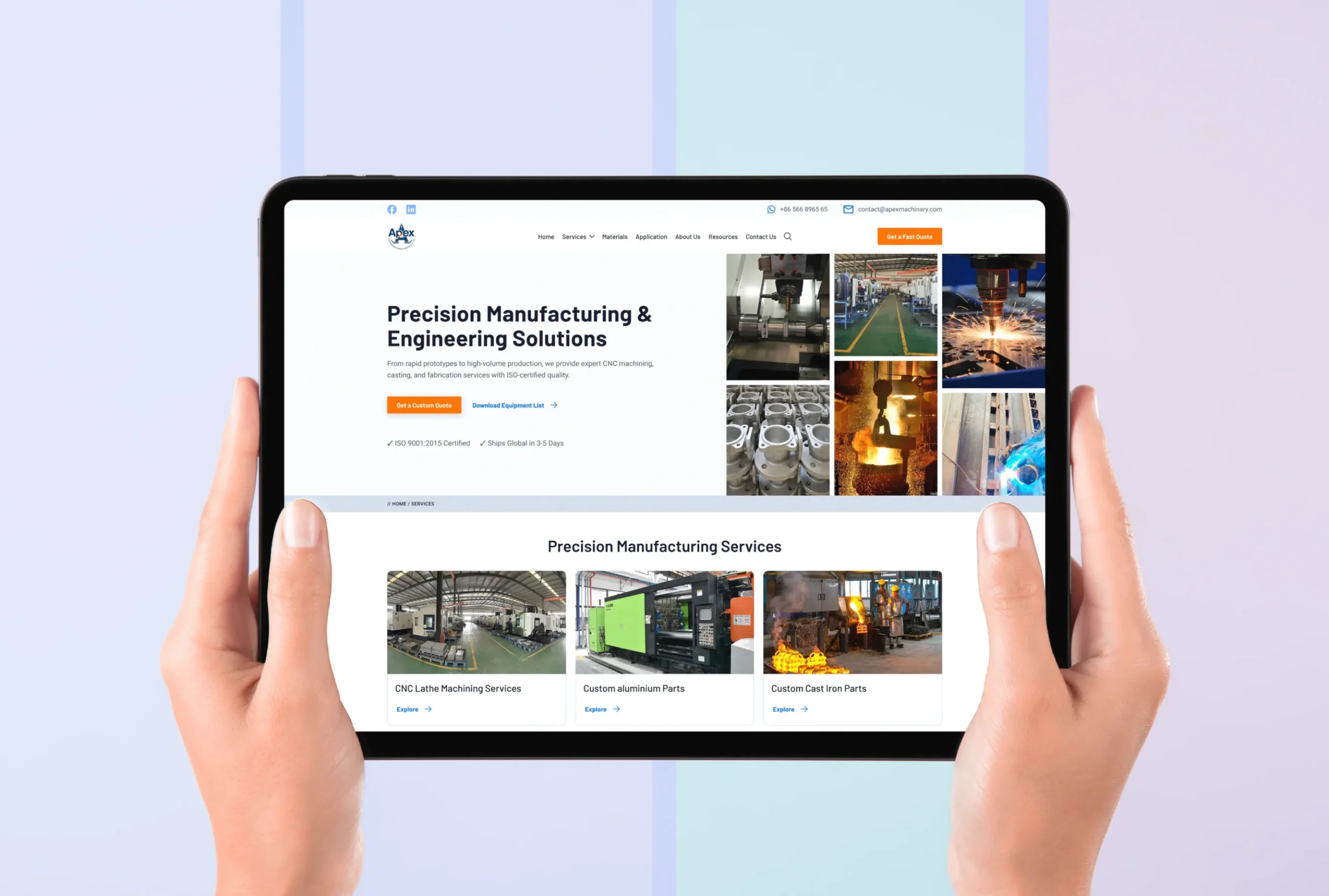
For heavy industry, partnering with a specialized Manufacturing UX/UI Designer is now the defining factor in securing marketplace survival over engineering precision alone. In 2026, the global supply chain is governed by conversational search intelligence and automated pre-vetting models that demand clear, structured data. If your technical data sheets, operating capacities, and regulatory certifications are locked inside unstructured code or buried within flat PDF links, your facility remains entirely invisible to modern corporate buyers.
This deep-dive guide exposes how traditional, minimalist agency layouts create catastrophic information friction for engineers. Discover how an experienced Manufacturing UX/UI Designer deploys high-density manufacturing web design optimized for AEO for manufacturers, layouts mathematical frameworks using a strict 12-column grid system, and builds an infrastructure primed for high-intent RFQ optimizations that turn search traffic into long-term enterprise contracts.
The Day an ISO 9001 Facility Was Erased by a Search Engine
The coffee machine at the Detroit automated tooling convention was loud, but it wasn’t enough to drown out the frustration in Raymond’s voice.
Raymond was the Director of Global Engineering for a multi-axis CNC machining corporation. His plant housed over forty precision machining centers, passed rigorous aerospace quality compliance audits, and consistently maintained component tolerances under half a micron. His machinists were artists in titanium; his factory floor was an immaculate, climate-controlled showcase of American manufacturing power.
“Ferdaus,” he said, turning his tablet toward me as we stood near the main exhibition hall. “We just lost our position on a rolling five-year supply contract for an electric powertrain assembly. The procurement manager at the automotive OEM is a guy I’ve had drinks with for a decade. When I asked him why our shop didn’t even make the preliminary bidding pool, he showed me his screening log.”
Raymond tapped the screen, opening a clean text window from a conversational enterprise AI agent.
“The buyer didn’t spend weeks clicking through web pages or looking at digital brochures,” Raymond explained, his finger tracing the text. “He gave his internal procurement AI a single command: ‘Scan the midwest region for ISO 9001 certified contract manufacturers with open capacity for ultra-high precision, five-axis milling of Grade 5 titanium engine mounts. Filter out suppliers that do not list their exact travel dimensions, spindle speeds, or tool change speeds on-page. Output a side-by-side technical capability index.'”
The automated AI search agent crawled the entire digital manufacturing market in seconds. It bypassed superficial branding statements, ignored flash videos of metal sparks, and completely swept past empty text headers. It was hunting for raw, structured engineering telemetry.
“The AI generated a list of three regional facilities with direct citations,” Raymond said quietly. “Our company wasn’t on it. Our website had plenty of pictures of our building and a beautiful paragraph about ‘our dedication to excellence,’ but our actual machine spec grids were trapped inside a downloadable asset links folder. The AI couldn’t parse the layout, assumed we lacked the hardware capability, and moved on. We were eliminated from a multi-million dollar contract before a human being ever looked at our name.”
The Dual-Force Landscape: Designing for Humans and LLM Crawlers
What happened to Raymond’s facility is the quiet reality of the modern industrial ecosystem. As a specialized Manufacturing UX/UI Designer, I see this structural disconnect every single day.
For decades, industrial marketing relied on historical momentum, trade show handshakes, and legacy vendor networks. When companies finally moved online, they hired generalist consumer web agencies. These agencies brought retail design metrics to heavy industry—prioritizing massive fields of empty whitespace, abstract emotional headlines, and hidden navigation paths.
But in the current digital landscape, that approach is a massive business liability. To capture high-ticket contracts, an Industrial Website Designer must optimize for two completely separate masters:
The Conversational Search Crawler (The AI Authority Matrix):
AI models do not look at your website layout to admire its colors. They analyze data structures through semantic entity mapping. They scan your backend architecture for clear, structured telemetry to present as immediate answers inside conversational windows—known as AI snippets.
The Industrial Procurement Director (The Engineering Trust Loop):
Once your digital asset wins an AI citation, a human engineer lands on your page. They are experiencing high cognitive pressure. They do not want to wade through lifestyle marketing text. They need to instantly verify your travel axes, component tolerances, material proficiencies, and quality assurance workflows.
If your platform fails the AI crawler, your visitor traffic drops to zero. If your visual system fails the human engineer, your bounce rate climbs, and your estimators go hungry. This is why standard web design fails. To win, a B2B UX designer must combine raw data integrity with factory-grade visual layout logic. We call this AEO for manufacturers backed by technical manufacturing web design.
Eradicating Information Friction: The Death of the Lifestyle Layout
The core issue plaguing traditional manufacturing web properties is information friction. This happens when an agency treats a highly complex component factory as if it were an online fashion store or a creative design portfolio.
When a lead procurement officer or design engineer searches for a contract manufacturing partner, they are not on a casual browsing trip. They are performing a calculated technical audit. They have a blueprint open on one screen and your website on the other.
If your homepage hides your operational specifications behind vague, minimalist statements like “Innovating the Future of Machining,” you force the user to work to find the truth. Every extra click you require an engineer to make to find your certification numbers or machine capacity lists builds cognitive friction. If they cannot find your data within five seconds, they assume you lack the capabilities and return to the search results. Minimalist consumer trends that replace data density with empty space confuse search algorithms and alienate engineering buyers.
Structural Semantic Silos: Engineering the Code Layout

To ensure your technical platform is perfectly indexed by both traditional search parameters and conversational AI crawlers, your entire site configuration must follow an orderly, isolated structure. We replace messy, flat directory paths with a highly organized Hub-and-Spoke Content Silo array.
By siloing your content paths, you build clear topical boundaries across your domain. When an AI crawler maps the relationships across your /industrial-machinery-automation/ silo, it doesn’t encounter mixed contextual data. It finds an unbroken chain of technical specs, engineering processes, and machinery capabilities. This clean data structure makes it incredibly easy for search bots to extract precise answers, instantly positioning your brand as an elite source for AI snippets.
The 12-Column Grid Discipline: Maximizing Visual Scannability
Once your information tree is mathematically organized, we apply the same structural discipline to the visual layout. In my practice as a Manufacturing UX/UI Designer, I build every interface on a rigid, highly calculated 12-column grid system.
This structural layout directly mirrors the geometric precision of a high-tech assembly line. By mapping every heading, image asset, and engineering chart to a mathematically consistent grid, we establish an immediate visual rhythm.
Engineers excel at reading technical drawings and clear schematics; they naturally look for structural alignment. By presenting dense data sets in clean, geometric layouts, we significantly lower user fatigue. The visual interface remains incredibly polished and modern while displaying the massive data density required to earn corporate trust.
Answer Engine Optimization (AEO): Coding for AI Snippets
To ensure your equipment specs and machining tolerances dominate modern conversational engines, your site text must be programmed for easy machine synthesis. We execute this through a dedicated dual-layer strategy:
Question-to-Specification Conversational Mapping
Enterprise buyers use natural, conversational sentences when prompting AI tools. They ask: “What are the exact multi-axis travel tolerances and load metrics for heavy industrial automation systems operating inside clinical cleanroom spaces?”
We match this search behavior by designing your headers and text blocks around these exact technical questions. When an AI crawler matches a user’s question directly to a clear heading on your site—followed by a factual, high-density table answering that exact query—your platform is chosen as the primary cited source.
Deep JSON-LD Schema Integration
Behind the visual interfaces built inside Figma, we embed customized, highly technical Schema code into your platform’s backend architecture. This structured data explicitly translates your physical assets, material capabilities, and certifications into a unified format that search spiders can parse instantly. Your machine capabilities are defined directly in the code, ensuring you win top-tier citations in conversational search results.
Capturing High-Ticket Contracts: High-Intent RFQ Optimizations
The ultimate objective of any elite B2B UX designer is converting traffic into qualified, high-value inquiries. Standard websites fail here by using a lazy, generic “Contact Us” box that asks for nothing but a name, email, and a blank text message field.
This unstructured layout causes immediate friction for engineers who cannot easily paste complex blueprints or GD&T parameters into an empty box. It triggers a slow, manual email loop that delays quoting and kills momentum.
Our manufacturing web design strategy removes this barrier by replacing generic boxes with interactive RFQ optimizations hubs:
- Technical Data Fields: Drop-downs that prompt procurement managers to define target materials, precision tolerances, and production volumes right at the start.
- Secure Engineering Blueprint Gates: Integrated, secure file upload zones that allow buyers to attach heavy CAD drawings or STEP files safely and directly.
- Immediate Internal Routing: Automated parsing that formats incoming inquiries into clean data sets, allowing your estimating team to issue accurate quotes faster.
From Blueprint to Production Line: Turnkey Agency Execution
Building a digital presence that perfectly balances immense data density with an elite visual layout requires a dedicated production engine. I structured my consulting model to completely eliminate the bloated overhead and communication gaps of traditional corporate agencies.
I personally manage your high-level strategy, technical data auditing, and visual layout configuration in Figma, constructing a tailored design system built precisely for your vertical markets.
Once the strategic blueprints are locked, my specialized production engine at Pixerts handles the implementation. Pixerts is a lean development house of four technical specialists who translate verified design files into fast, secure, clean-code WordPress platforms. We don’t use plugin-heavy templates that slow down loading speeds across international supply chain lines. We build fast, responsive digital assets engineered to secure your technical competitive advantage.
Frequently Asked Questions
1. Why do industrial websites require high information density instead of minimalism?
Answer: Industrial procurement managers and design engineers use your website as a technical validation tool. They need immediate access to tolerances, capacities, and compliance certifications to verify your production capabilities. Hiding this critical data behind empty whitespace increases information friction and drives buyers away.
2. What makes AEO for manufacturers different from standard industrial SEO?
Answer:Traditional SEO focuses on ranking pages within standard search listings by targeting human keyword queries. AEO for manufacturers maps and tags your technical catalog data using deep schema so conversational AI search models can quickly synthesize your hardware capabilities and recommend your brand.
3. How does a 12-column grid system improve user conversion rates?
Answer:Engineers are trained to interpret highly structured technical schematics. By using a strict 12-column grid system, you create an orderly visual path that matches their scanning habits, reduces cognitive load, and helps them locate specific machine specs within seconds.
4. What is an RFQ optimization intake portal?
Answer:An RFQ optimization portal is an engineered digital form that replaces standard contact boxes. It streamlines the procurement process by explicitly capturing engineering parameters—such as material grades, precision tolerances, and production scaling targets—and includes secure upload areas for native 3D CAD files.
5. Why do you use a platform-agnostic design process backed by Pixerts?
Answer:We design your custom, component-driven visual systems entirely inside Figma to guarantee absolute structural precision. Once validated, my lean team of four development specialists at Pixerts handles the clean-code WordPress implementation, delivering a stable, fast, and secure platform built to scale easily.